
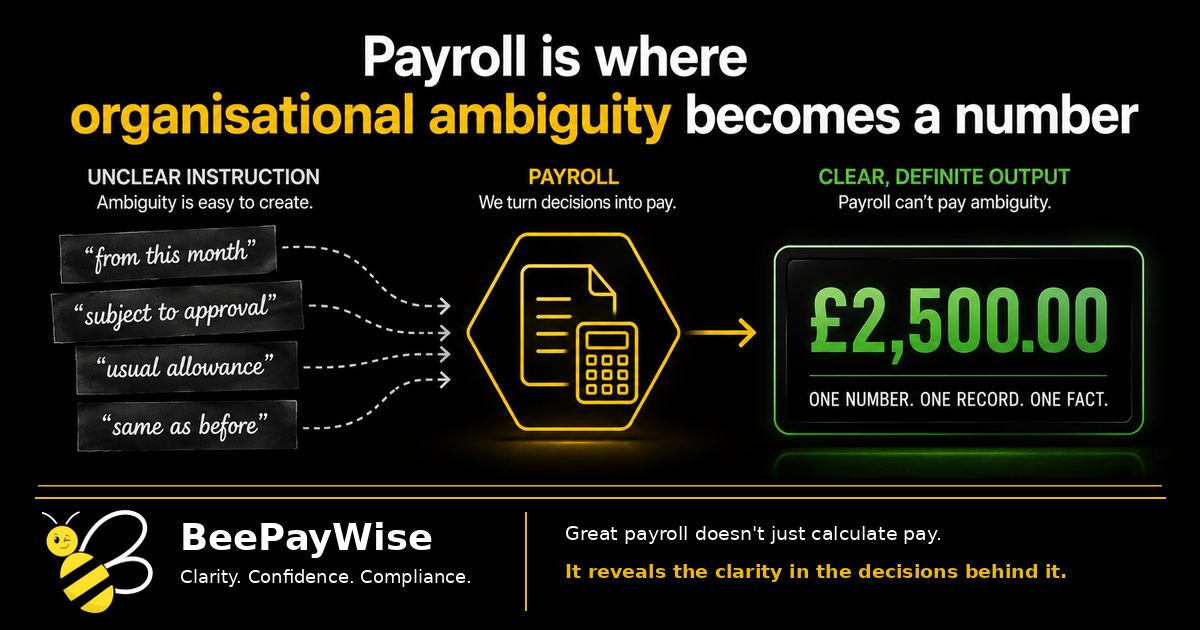
Payroll is where organisational ambiguity becomes a number
“Pay her the higher rate from when she tookover the role.”
At first glance, there is nothingparticularly difficult about that instruction. The employee has taken on adifferent role, a higher rate has been agreed and payroll needs to apply it.
Then someone asks when she took over therole.
Her manager considers it to be the point atwhich she started performing most of the duties. HR has an approved change witha later effective date. The employee understood that the higher rate wouldapply from when she was first asked to cover the role.
The original instruction has not changed,but it no longer looks quite so complete. Before payroll can turn it into pay,somebody needs to establish which date applies.
Situations like this are not unusual.Businesses make decisions through conversations, emails, policies, meetings andestablished ways of working. People often understand broadly what is meant andwork carries on. Payroll has less room for ambiguity because eventually thosedecisions need to become amounts paid to employees.
“From when she took over the role” needs adate. “Pay the appropriate rate” needs an amount. “Include the additionalhours” requires enough information to establish which hours qualify and howthey should be paid.
Payrolldoes not create the need for certainty. Paying the employee does.
When an instruction is not yet a decision
Sometimes the missing information isstraightforward. A date has been omitted from an otherwise completeinstruction, somebody provides it and processing continues.
Other cases expose something theorganisation has not actually resolved. Two managers may agree on the facts butinterpret a policy differently. HR and operations may have differentunderstandings of when a change takes effect. Everyone may know what needs tohappen but be unclear about who has authority to approve it.
These can arrive in payroll looking likerequests for clarification when what is actually missing is a decision.
A payroll professional can identify theinconsistency, explain what information is needed and help those involvedunderstand the payroll consequences. That does not necessarily give payroll theauthority to choose the answer.
Knowing the likely answer is not the same as deciding it
Experience makes payroll professionals goodat recognising familiar situations. They know how the organisation normallyhandles a payment, what a manager probably intended and what has happened insimilar circumstances.
That knowledge is valuable. It helpspayroll identify unusual instructions, ask relevant questions and deal sensiblywith minor omissions. But there is a boundary between applying an establishedrule and choosing between reasonable interpretations because one seems morelikely.
Quietly filling that gap may get thepayroll completed, but it can also hide the fact that a decision was missing.If the same approach is then followed next time, an answer chosen forconvenience can gradually begin to look like an established rule.
Experience should help payroll recognisewhen an answer already exists and when somebody with the appropriate authoritystill needs to provide one.
Repeated requests for the sameclarification can also be useful. If effective dates are regularly disputed, aprocess may need tightening. If a particular payment repeatedly requiresinterpretation, the policy may be less clear than people assume. Payroll doesnot need to own those problems to help the organisation see them.
From words to pay
Payroll receives decisions made across anorganisation and turns their financial consequences into pay. That meansapproximate dates, assumed approvals and slightly different interpretationseventually have to become definite enough to process.
The answer is not for payroll to make everyunresolved decision itself. A good payroll function needs to understand what itcan properly determine, what requires clarification and when the business needsto provide the answer.
The employee in our original example doesnot need to know about any of this. She needs to receive the right amount ofmoney from the right date.
For that to happen, “from when she tookover the role” eventually has to become a date.
Payrollis often where the business discovers whether its words are clear enough tobecome pay.
Ready To BeePayWise?
Let’s make your payroll the sweetest, calmest part of your month. Book a hive chat for a no-strings mini-diagnostic, or drop us a message and we’ll buzz right back.