
The PayrollCalculation Was Right. The Conclusion Wasn't.
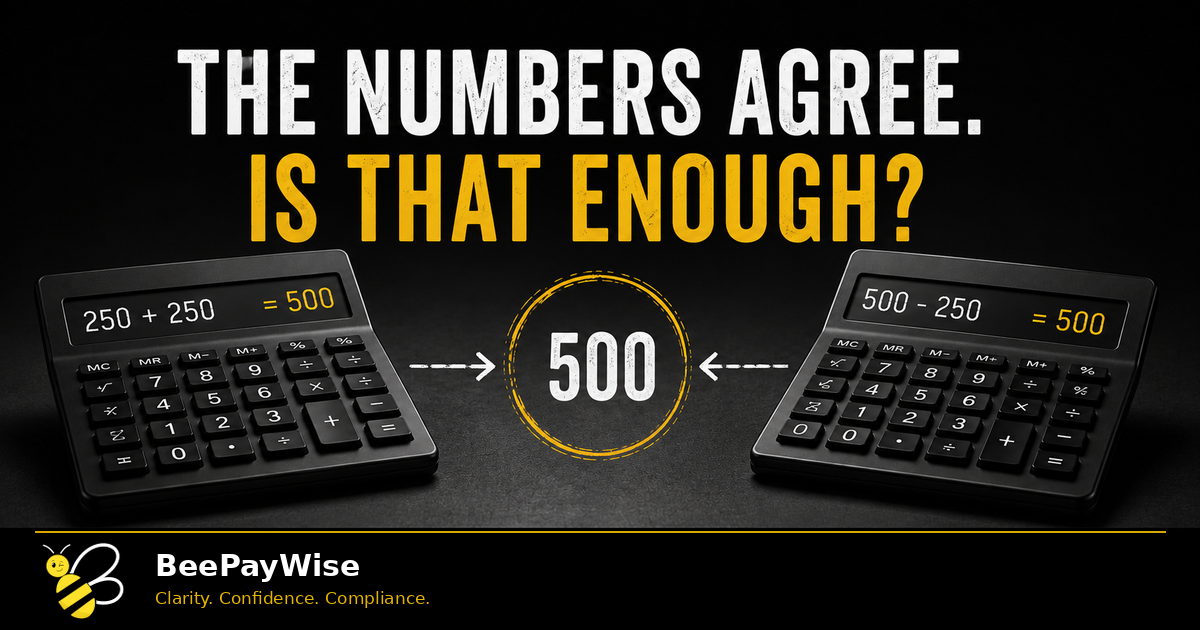
A calculation can tell you whether apayroll process worked in the circumstances you gave it. Deciding whether thatis enough evidence to rely on the process is a different question.
Consider a £500 payroll overpayment. Oneway of recovering it might be to reduce the employee's gross pay by £500 in thefollowing month. If that process is to be treated as equivalent to correctingthe original error, we need to know whether it also restores the statutorypayroll position that should have existed.
A worked example appears to provide theanswer. An employee who should have earned £2,000 in each of two monthsreceives £2,500 in the first and £1,500 in the second. The £500 has beenrecovered, total earnings remain £4,000 and the National Insurance is exactlythe same as if the employee had received £2,000 in each month.
On those facts, the process works. Thecalculation is correct and the result is persuasive. What it hasn't establishedis whether the process works because it is technically equivalent to correctingthe original payroll, or because of the particular earnings circumstances wehappened to test.
That distinction gives us somewhere usefulto look. At £2,000 a month, moving £500 between the two periods does not takethe employee's earnings through a National Insurance threshold. If the processis going to behave differently anywhere, changing that relationship with thethresholds is an obvious place to test it.
Keep the £500 overpayment, the £500recovery and the same total earnings, but lower the employee's normal earnings.Now moving £500 between periods takes earnings across the Primary Threshold.Nothing about the recovery process has changed, yet the National Insuranceresult is different.
That happens because National Insurance iscalculated by earnings period. Moving earnings from one period to another cantherefore change the statutory calculation even though the employee's totalearnings across the two periods remain exactly the same.
The first calculation wasn't wrong. Itanswered the question it had been given perfectly well. The weakness was intreating that answer as evidence that the process itself would produce anequivalent statutory result more generally.
A successful calculation had shown that theprocess worked in one set of circumstances. Changing those circumstancesexposed its limitation. What initially looked like confirmation turned out tobe only part of the answer.
Sometimesthe most dangerous payroll result isn't the one that's obviously wrong. It'sthe one that looks right for the wrong reason.
Thisarticle is supported by BeePayWise Technical Review BTR-001: Correction ofErroneous Payroll Overpayments under RTI.
Ready To BeePayWise?
Let’s make your payroll the sweetest, calmest part of your month. Book a hive chat for a no-strings mini-diagnostic, or drop us a message and we’ll buzz right back.