
What repeated payroll corrections are trying to tell you
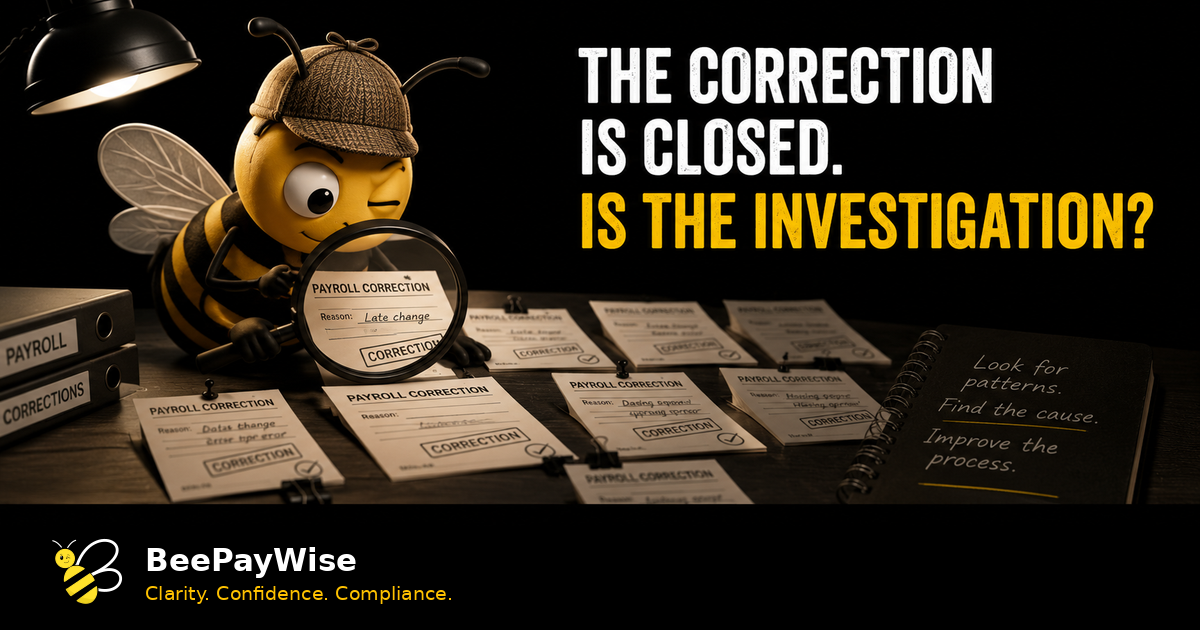
Most payroll teams know how many corrections they make; the best ones find out why.
Imagine a payroll that records 15 corrections over several months. The number tells us something about additional workload and may deserve attention if it starts to increase, but it does not tell us whether those corrections have anything in common.
One relates to overtime entered incorrectly, another to incomplete starter information, while several employees were affected by contractual changes received after the payroll cut-off. Each counts as one correction, although the causes are quite different.
Now suppose eight of the 15 corrections arose from late contractual changes. Once the causes are visible, so is a possible weakness in the way contractual changes reach payroll.
Looking beyond the correction
The immediate purpose of a correction is to put something right. Once that has been done, closing the issue and moving on is understandable, but it can also mean losing useful information about why the correction was needed.
Recording that an employee's salary was corrected describes what happened to their pay. Recording that an approved contractual change reached payroll after the cut-off identifies something about the process behind it. If the same cause begins to appear repeatedly, there may be something worth investigating.
Missing overtime provides a good example. Several corrections might initially look alike, but their causes could be quite different. Managers may be approving overtime late, employees may be submitting information incorrectly or the process itself may make timely submission difficult. Knowing which is happening matters if the organisation wants to improve anything rather than simply become more efficient at making corrections.
Finding meaningful patterns
Not every group of corrections points to a failing process. Three unrelated mistakes may simply be three unrelated mistakes, while an increase in corrections during rapid recruitment or organisational change may be entirely understandable.
Volume also changes the picture. Ten unrelated corrections across a payroll of thousands of employees tell a different story from ten instances of the same problem in a much smaller payroll.
Cause only becomes useful when considered alongside frequency, scale and consequence. A recurring issue affecting a significant number of employees may justify attention, while an occasional exception might demonstrate nothing more than the reality of running payroll in an organisation where people, systems and deadlines interact.
The aim is not to find a process failure behind every correction. It is to recognise when apparently separate events have enough in common to deserve a closer look.
Making correction data more useful
This does not require an elaborate reporting system. For many organisations, the useful change may simply be recording a meaningful cause when a correction is made.
Useful categories reflect the organisation and distinguish between causes that might require different responses. Late information, incorrect input, missing approval, system issues and payroll processing errors might be useful starting points, but categories that merely add administration without improving understanding achieve very little.
Over time, the causes can be reviewed alongside the number of corrections. A pattern of late contractual changes might lead the business to examine how information moves between HR and payroll. Repeated late approvals may require attention from managers, while recurring payroll processing errors quite properly lead back to payroll.
Good payroll does not need to own every solution to help the business see where a solution is needed. Sometimes a payroll control can identify a problem earlier; preventing it may require a change somewhere else in the process.
Corrections will never disappear entirely, nor should eliminating every correction become the objective. Mistakes happen, circumstances change and exceptions are inevitable.
What matters is that useful information does not disappear when the correction is closed. If you already record how many payroll corrections you make, recording why they were needed can give you a much better understanding of what those numbers actually mean.
Ready To BeePayWise?
Let’s make your payroll the sweetest, calmest part of your month. Book a hive chat for a no-strings mini-diagnostic, or drop us a message and we’ll buzz right back.